
Eastern Vareth
Shattered Glass
The land that catches the light.
Crystal heights, living runes, and the communities that make a home among them.Regional identity
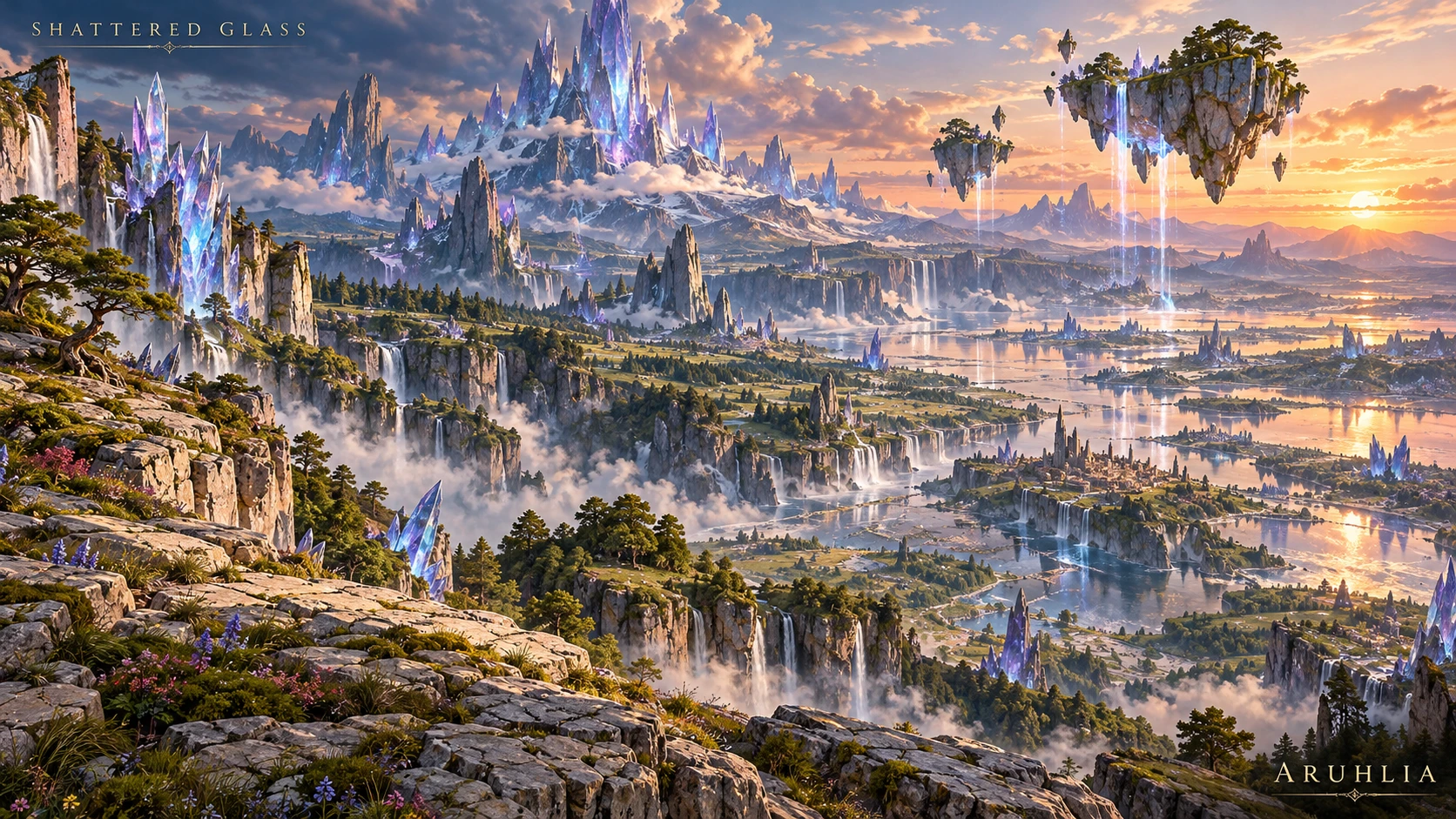
At a distance, Shattered Glass appears to be a country assembled from the pieces of a broken sky. Pale stone rises through vegetation in immense fractured shelves. Crystal outcrops catch sunlight long after the ground lies in shadow. Between the taller formations, suspended islands cast slow-moving darkness across the slopes beneath them. At night, certain seams remain luminous, and the inhabited valleys become constellations of shuttered windows.
This is Vareth's region of highest naturally ambient mana density. Its inhabitants live beside resources that distant nobles, artificers, scholars, and adventurers are willing to pay dearly to obtain. Yet wealth is uneven. A family can occupy a hillside above valuable crystal and still lack the money to repair its roof: extraction requires tools, transport, working knowledge, and buyers who control grading.
The region's defining tension is possession versus access. Who owns a useful outcrop? Who maintains the route to it? Who bears the cost when excavation destabilizes the neighboring shelf? Who decides that a vein must rest? These arguments reach from kitchens and workshops to charter courts and noble patronage.
The local saying is: “Look twice. Step once.” It applies equally to footing, contracts, and courtship.
Land, water, and mana
The landscape is a mosaic of broken mineral uplands, sheltered cultivated pockets, exposed reflective flats, and subterranean passages. Ordinary soil accumulates where roots and sediment can hold it. Bare formations can be spectacular but agriculturally poor. This gives the region green margins, inhabited terraces, and working farmland instead of an uninterrupted crystal desert.
Mana concentration fluctuates locally. A quiet valley within Shattered Glass can be less saturated than a nearby fault gallery while the region retains its continental distinction. Residents choose house sites for stable ground and predictable conditions rather than maximum brightness. A spectacular view is not necessarily a safe foundation.
Ambient abundance is an opportunity, not an automatic refill, level increase, or bypass of personal capacity and regeneration. Useful collection requires compatible techniques or engineered equipment, with losses and maintenance. Ordinary visitors do not spontaneously grow crystal armor or biological runes. Established lineage adaptations remain essential.
Water is a practical constraint. Settlements maintain covered storage, separate work-water from household water, and inspect channels after falling debris. Glittering water is not assumed potable. The luminous Mana Falls are not necessarily ordinary liquid water, and their relationship to nearby waterways remains uncertain.
The cause of the original landscape remains open. Locals tell competing accounts of a celestial fracture, a lost experiment, and a country that crystallized slowly around natural mana convergence. No single account has been established. Bulwark manufacture likewise does not prove that one lost civilization made the entire region.
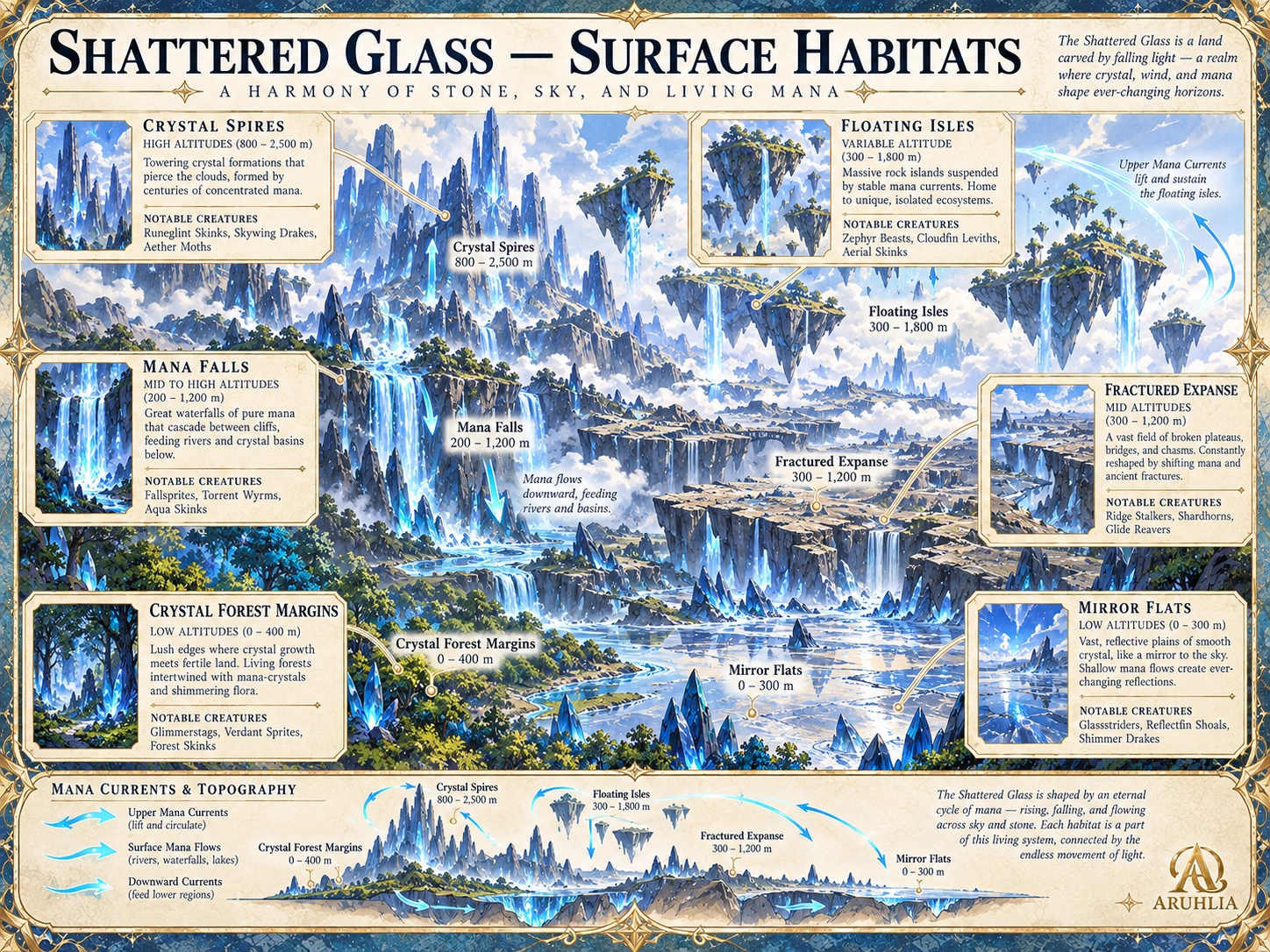
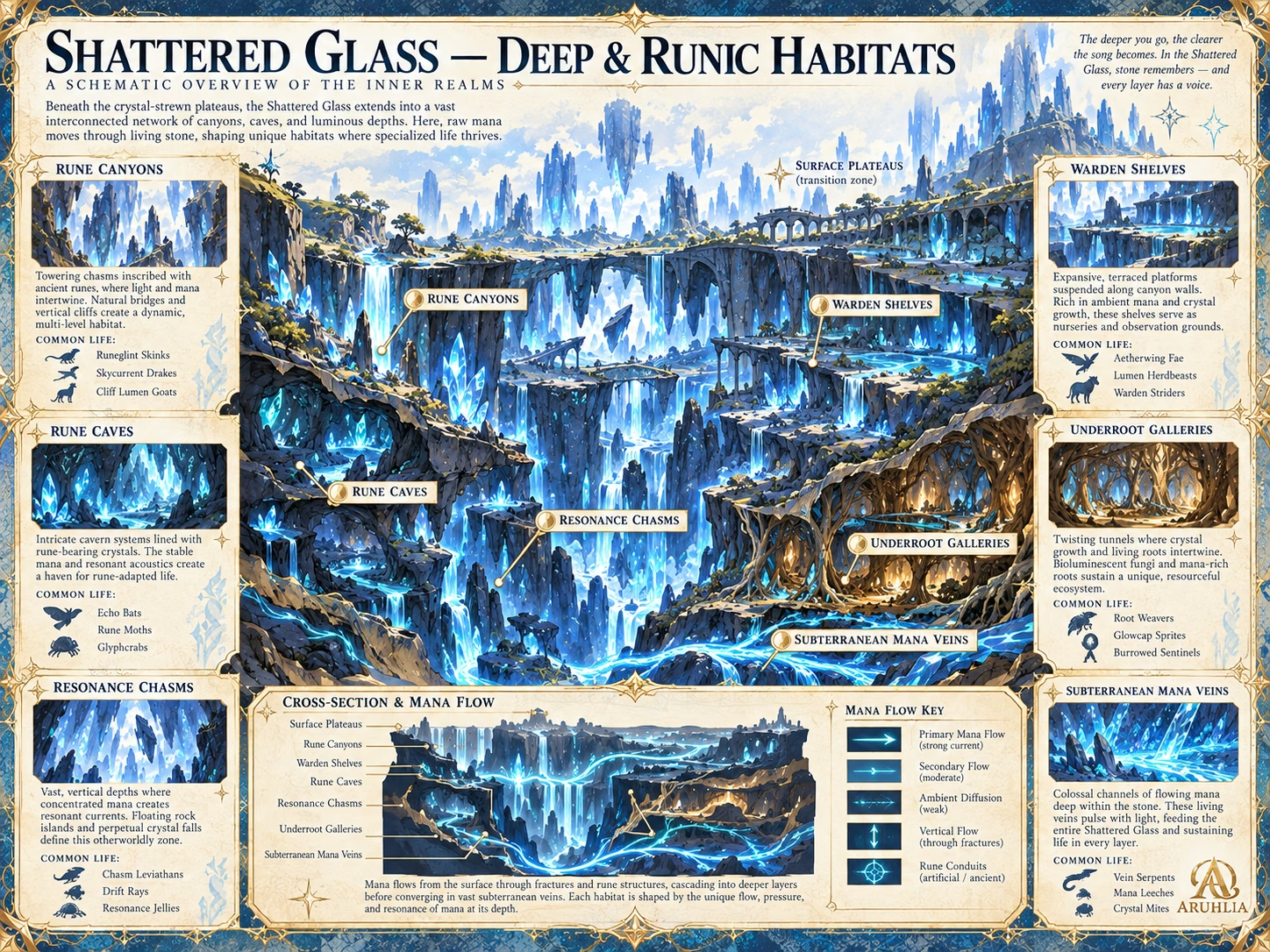
The twelve habitat districts
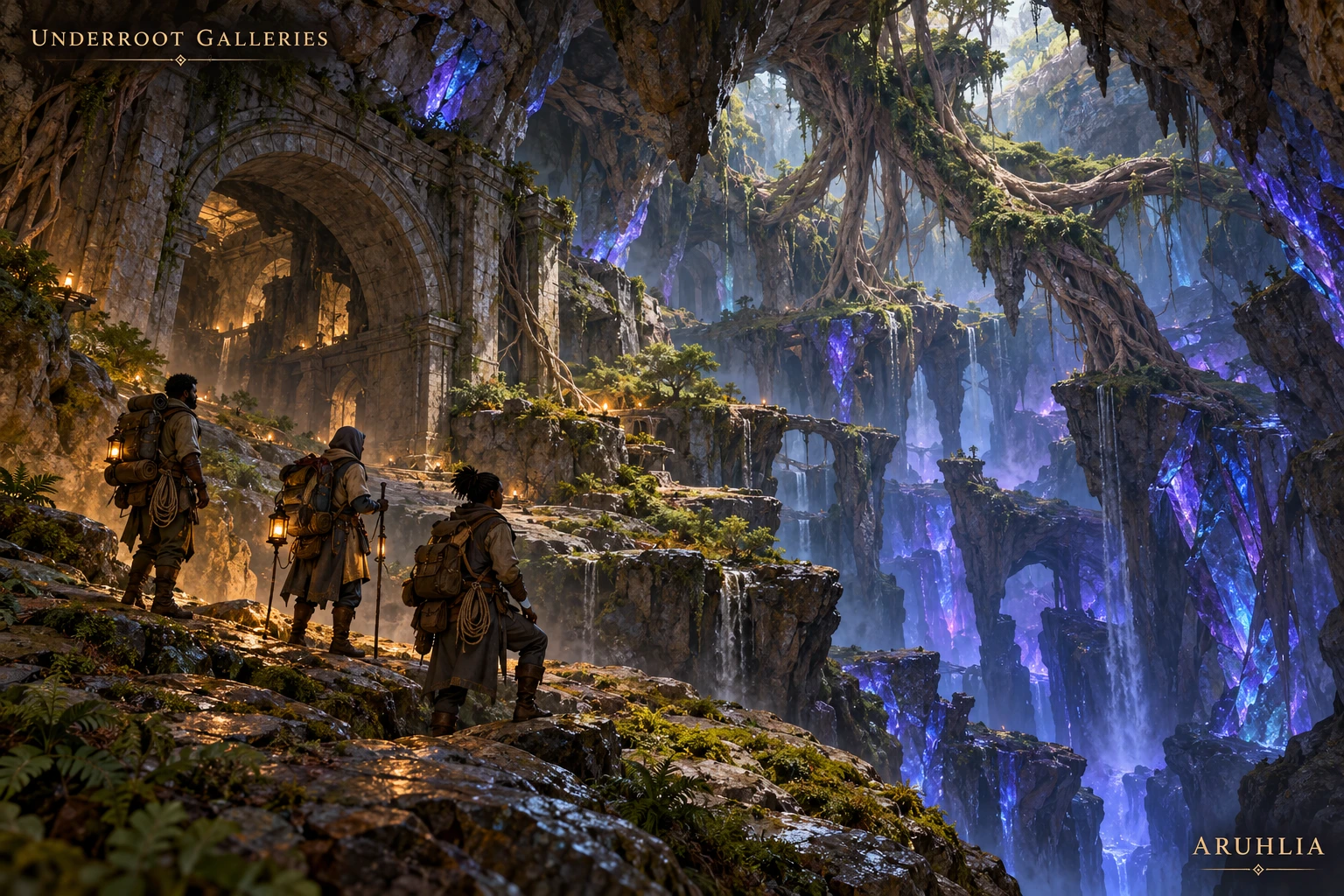
These habitat districts describe the land’s ecological variety.
| Existing habitat | Expanded character and use | Pressure and field signs |
|---|---|---|
| Crystal Spires | Tall growths and exposed ledges; careful prospecting and observation stations | Nest defense, falling fragments, wind-amplified vibration; fresh debris closes approaches |
| Floating Isles | Suspended stone habitats with sheltered upper surfaces and inaccessible undersides | Aerial territories, uncertain footing and changing access; island motion must be observed rather than assumed predictable |
| Mana Falls | Luminous cascades and convergence scenery; field study from stable overlooks | Glare, noise, local magical interference; visitors must distinguish light from water |
| Fractured Expanse | Broken mineral ground with pockets of scrub and open crossing country | Hidden fissures and collapsing edges; old cairns can outlive the safe path they once marked |
| Crystal Forest Margins | Living woodland interspersed with mineral formations, soil pockets, and shaded understory | Brush concealment and competing claims to resin, fuel, and crystal; not every trunk is crystal |
| Mirror Flats | Reflective surfaces interrupted by sediment islands and dull gravel | False horizons and difficult distance judgment; travel markers use matte surfaces |
| Rune Canyons | Sheltered cuts where exposed formations and living runic fauna share the landscape | Echoes obscure direction; access bottlenecks favor ambush and toll collection |
| Rune Caves | Stable chambers, broken passages, and nesting or shelter sites | Low visibility and confined escape; surface markings do not prove passage continuity |
| Resonance Chasms | Deep fractures where sound and mana effects become locally conspicuous | Noise, loose edges, and underground predation; a changed echo can announce a collapse |
| Warden Shelves | Broad convergence terraces used by living Glyphmaw Wardens | Seasonal access changes and trampling risk; old feeding traces reveal recurring use |
| Underroot Galleries | Root-threaded underground margins beneath vegetated land | Damp organic pockets, decomposers, burrowers, and fragile ceilings; roots indicate life above, not a guaranteed exit |
| Subterranean Mana Veins | Concentrated geological seams and extraction targets | Overworking, theft, and instability; safe operation depends on observation and engineered support |
Mirrorford: trade, argument, and arrival
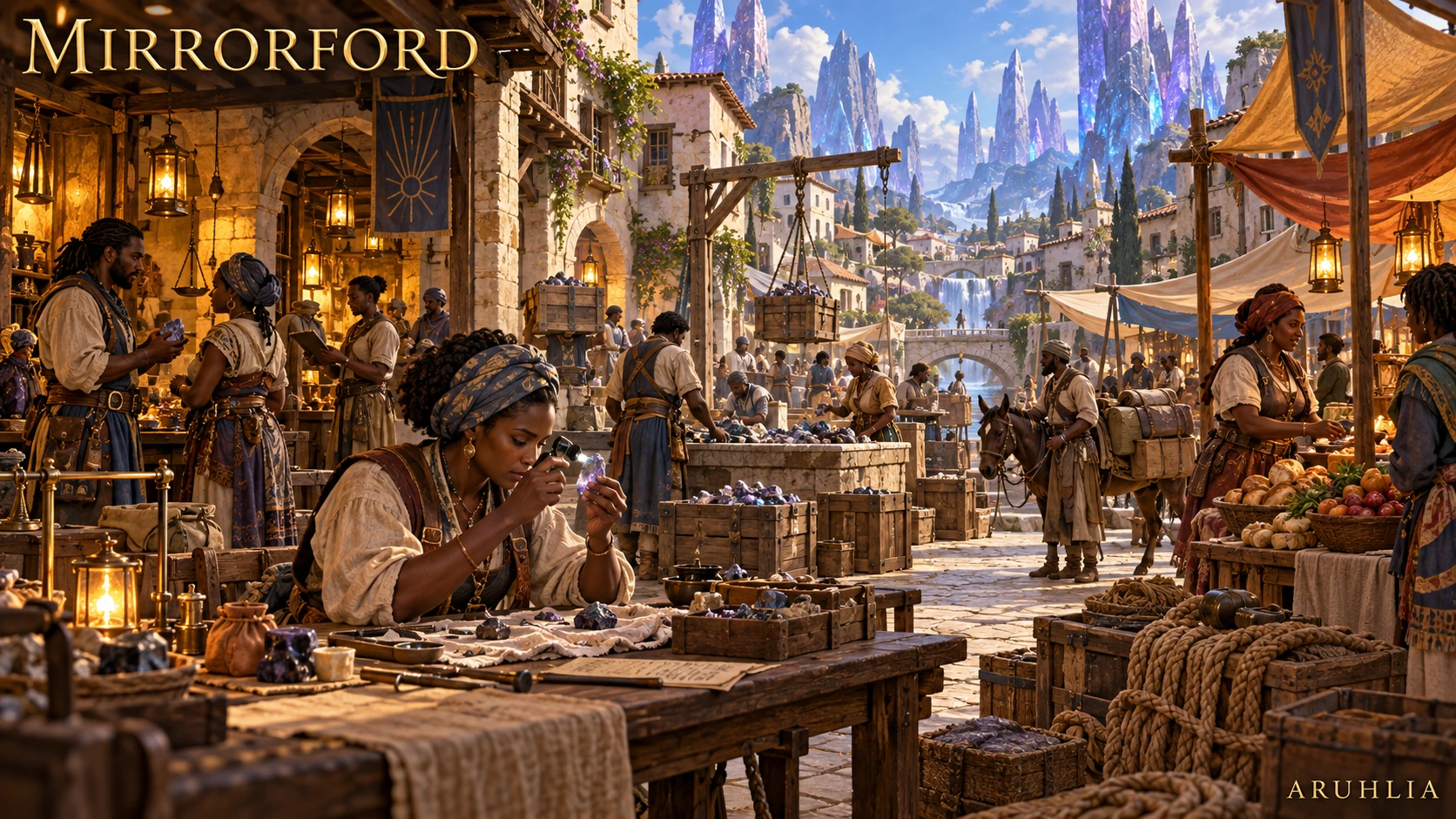
Mirrorford is the region's principal brokerage and supply town. It is where rough material becomes a graded shipment, where merchants hire guides, and where local grievances acquire witnesses.
Low, heavy buildings surround sheltered courts. Matte plaster and fabric screens soften the glare. Workshops face workyards rather than main streets, giving room for padded crates, pack animals, and loading crews. Wealthier buildings incorporate selected polished surfaces, while working households favor repairable shutters and inexpensive stone.
The Assay Court is a public yard where independent graders examine samples in controlled light. Fees buy examination, not guaranteed value. Disputes arise over provenance, inclusions, damage in transit, and whether a buyer substituted a sample. Its authority rests on witnesses and enforceable contracts, not a magical device that reveals every lie.
The Dull Lantern is an inn with shaded rooms, a courtyard kitchen, and a proprietor who rents secure sample lockers separately from beds. A quiet side room serves negotiations; by evening it also hosts musicians and private meetings. The Menders' Arcade houses lens polishers, leatherworkers, wheelwrights, rope sellers, and the people who make an expedition possible without ever joining one.
Mirrorford's poorest residents carry shipments, sort broken material, wash packing cloth, and sell food near the grading queues. Its prosperous families maintain relationships with buyers beyond the region. Its central political dispute is whether independent producers can afford enough storage to wait for a fair offer.
At the safe margin outside the razor-shard fields near Vath-Kar, protective-footwear makers and route pilots serve travelers alongside the mineral graders.
Open the settlement record →Bluefacet Watch: the cost of keeping passage open
Bluefacet Watch is a fortified observation and route-maintenance settlement. Its importance comes from dependable reports, protected storage, repair crews, and patrol coordination.
Its buildings have protected walkways, covered muster yards, spare timber stores, and observation shutters. The watch keeps duplicate records in separate rooms because a broken roof or workshop fire can otherwise destroy an entire season's route knowledge. Signal shutters can pass simple messages when visibility permits; they do not transmit unlimited detail across the continent.
The Open Ledger records closures, missing parties, recovered goods, and disputes over escort promises. The Quiet Yard is a sheltered rest and treatment court. The Broken Step is a modest eating house where repair crews and patrols share tables but argue over whose work takes the greater risk.
The watch needs wages, provisions, and replacement equipment. Merchants want predictable tolls. Local families resent paying for protection that seems to arrive first at valuable shipments. A commander can honestly fear a route failure while also overstating it to secure funding. Patrol members have lovers, sick parents, debts, private ambitions, and shifts they hope someone else will cover.
Beacons, crystal-lens maintenance, rescue teams, and sheltered stores support the crossing. Reflected signals can be mistaken for emergencies, making careful confirmation essential.
Open the settlement record →Lowglint: the country that feeds the brilliance
Lowglint is an agricultural and craft settlement associated with comparatively sheltered conditions. Its importance is ordinary abundance: stored grain, roots, vegetables, fodder, preserved food, mended equipment, and people willing to return after a bad season.
Homes gather around working gardens and shared processing yards. Soil is valuable enough to move deliberately and protect behind retaining walls. Reflective decorative material is used sparingly around crops. Fields occupy verified stable ground, not any surface that happens to look level.
The Common Granary holds household deposits and an emergency reserve governed by public accounting. The Shutter Market opens early and late, with covered midday stalls. The Root and Rafter serves thick stews, flatbreads, preserved fruit, and the local arguments that traders rarely hear until too late.
Lowglint exports provisions but fears dependence on imported seed and tools. Some families send one adult to seasonal extraction work; others refuse because a past injury consumed years of earnings. Young people leave for Mirrorford and return with money, debts, fashions, or partners. Residents do not all agree about mining: many supply it, many depend on it, and many distrust the people who set its terms.
Lowglint also maintains its established trades in safe glazing, precision grinding, water capture, and metal fastenings. Dust protection remains an everyday concern for its workers.
Open the settlement record →Routes and infrastructure
Three service circuits connect the existing settlements conceptually: a provisions circuit between Lowglint and buyers, an assay-and-export circuit centered on Mirrorford, and a repair-and-escort circuit coordinated through Bluefacet Watch. These circuits describe trade relationships; travelers rely on route pilots and current notices.
Travelers need shaded eye protection, stout soles, gloves for rough mineral surfaces, water, and gear appropriate to the actual terrain. Pack animals and carts remain useful on verified routes. Aerial access is specialist work: Crownwings are true dragons with four legs and two membranous wings, and aerial access depends on actual riders and conditions.
Waystations maintain dull-painted markers, sheltered waiting space, a repair cache, and a dated route notice. A guide sells recent knowledge. Yesterday's safe crossing can become today's missing ledge. Caravans commonly agree on an assembly window rather than a promised exact departure, because escort availability, freight inspection, and closures all interact.
Plants and the ordinary food web
Plants anchor the food web, shelter small wildlife, and support farming and craft.
| Plant | Habitat and ecological role | Human use and limit |
|---|---|---|
| Shardroot sedge | Tough clumps bind loose sediment at mineral margins; refuge for small invertebrates | Fiber for padding and coarse mats; uprooting entire stands accelerates erosion |
| Glintleaf shrub | Dull upper leaves and pale undersides in sheltered scrub; browsing and insect habitat | Fodder where locally established safe; brightness is not proof of edibility |
| Veilbark willow | Moist soil pockets | Flexible rods for baskets and wind screens; requires reliable water |
| Lanterncup flower | Seasonal blooms at forest margins support ordinary pollinating insects | Ornamental plant and local festival emblem; no automatic light spell |
| Ashmeal tuber | Cultivated in stable soil beds around Lowglint; requires ordinary fertility management | Dense cooking root; a failed harvest remains a serious shortage despite abundant mana |
| Threadmoss | Fine mats in damp Underroot Gallery margins; traps organic debris | Packing and nursery use after preparation; removing all growth damages the microhabitat |
Ordinary beetles, moths, small rodents, burrowing animals, scavenging birds, and decomposers fill the spaces between the spectacular creatures. Plants capture energy; herbivores and insects feed on plants; predators exploit those animals; decomposers return nutrients. Mana modifies these relationships without replacing every need for food, water, shelter, and reproduction.
Wildlife in a working ecology
Crystal and living runic adaptations support different ways of feeding, moving, sheltering, and defending territory.
| Entity | Ecological behavior | Signs, encounter, and material use |
|---|---|---|
| Shardfur Colossus — crystal | Wide-ranging highland omnivore using mineral-rich grounds; adults generally separate outside reproductive periods | Rubbed stone and coarse shed fur; dangerous at close contact. Naturally shed crystal fragments and fur are candidates for craft use |
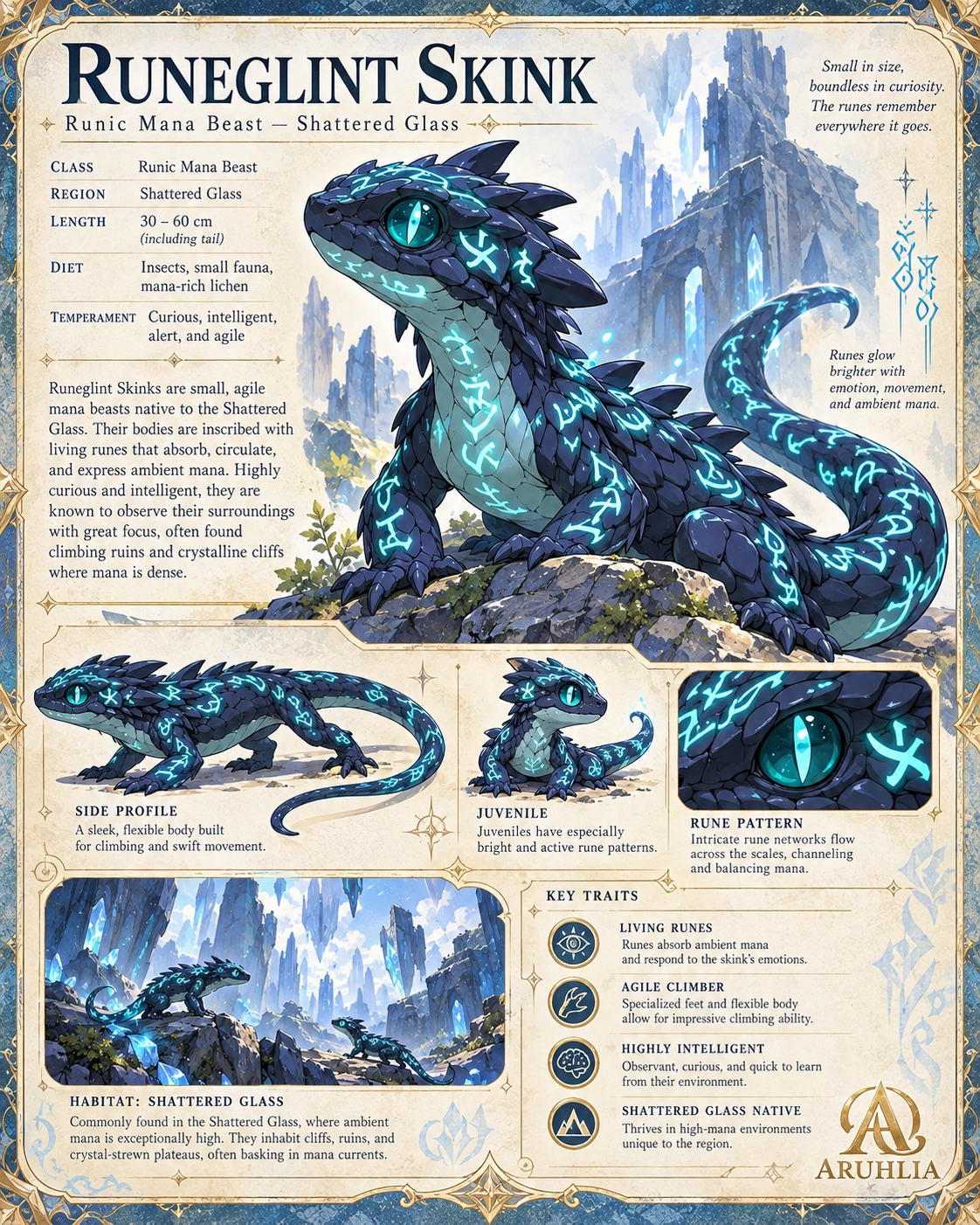
| Runeglint Skink — runic | Small ledge insectivore; shelters in narrow cracks and competes for warm resting sites | Quick flashes of living channels during movement. A skink-rich wall suggests insect activity, not a guaranteed safe campsite |
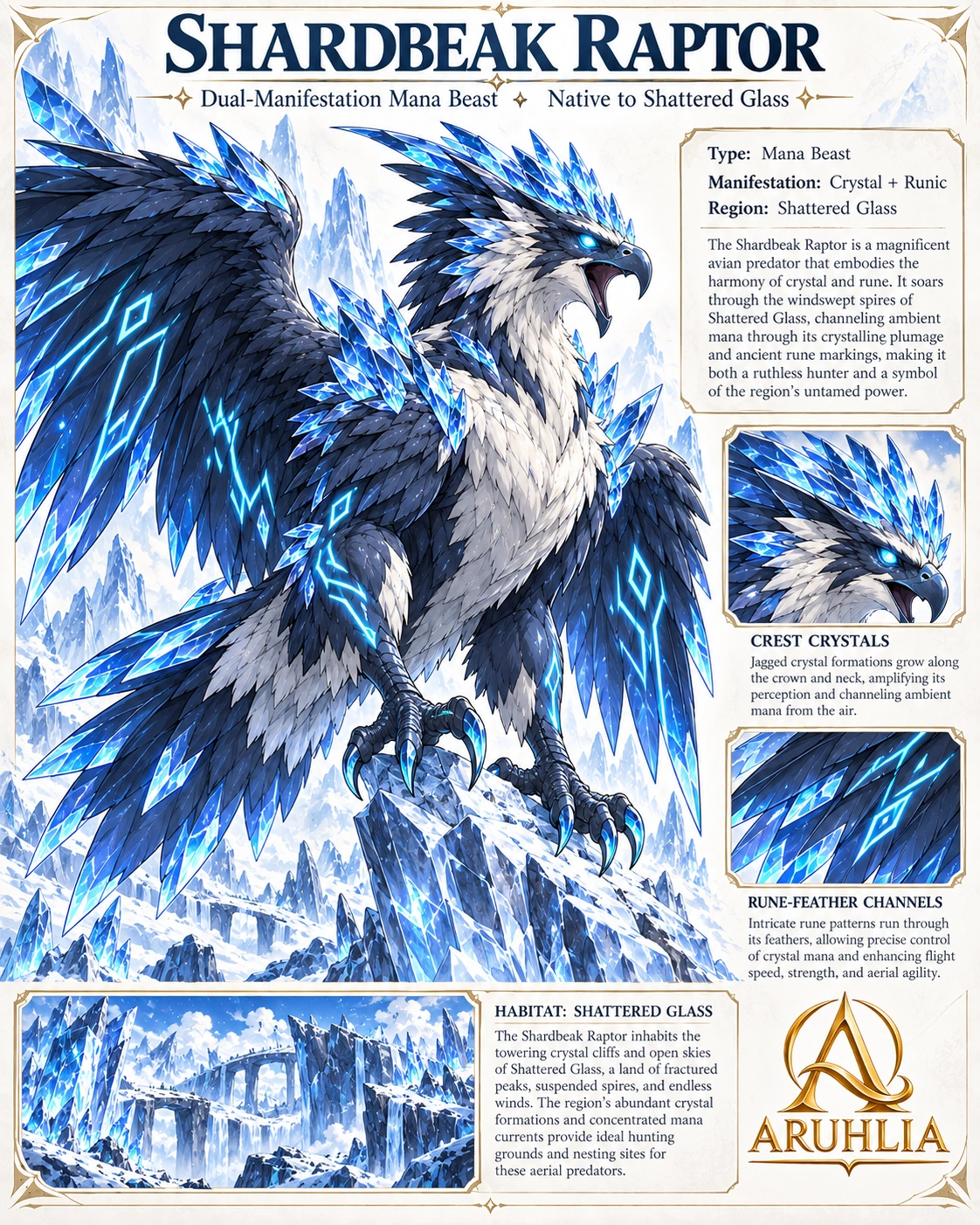
| Shardbeak Raptor — dual | Ledge-nesting aerial predator taking smaller animals; nests defended vigorously | Dropped prey remains and repeated approach paths. Naturally shed feathers are study material, not proof of a universal flight enchantment |
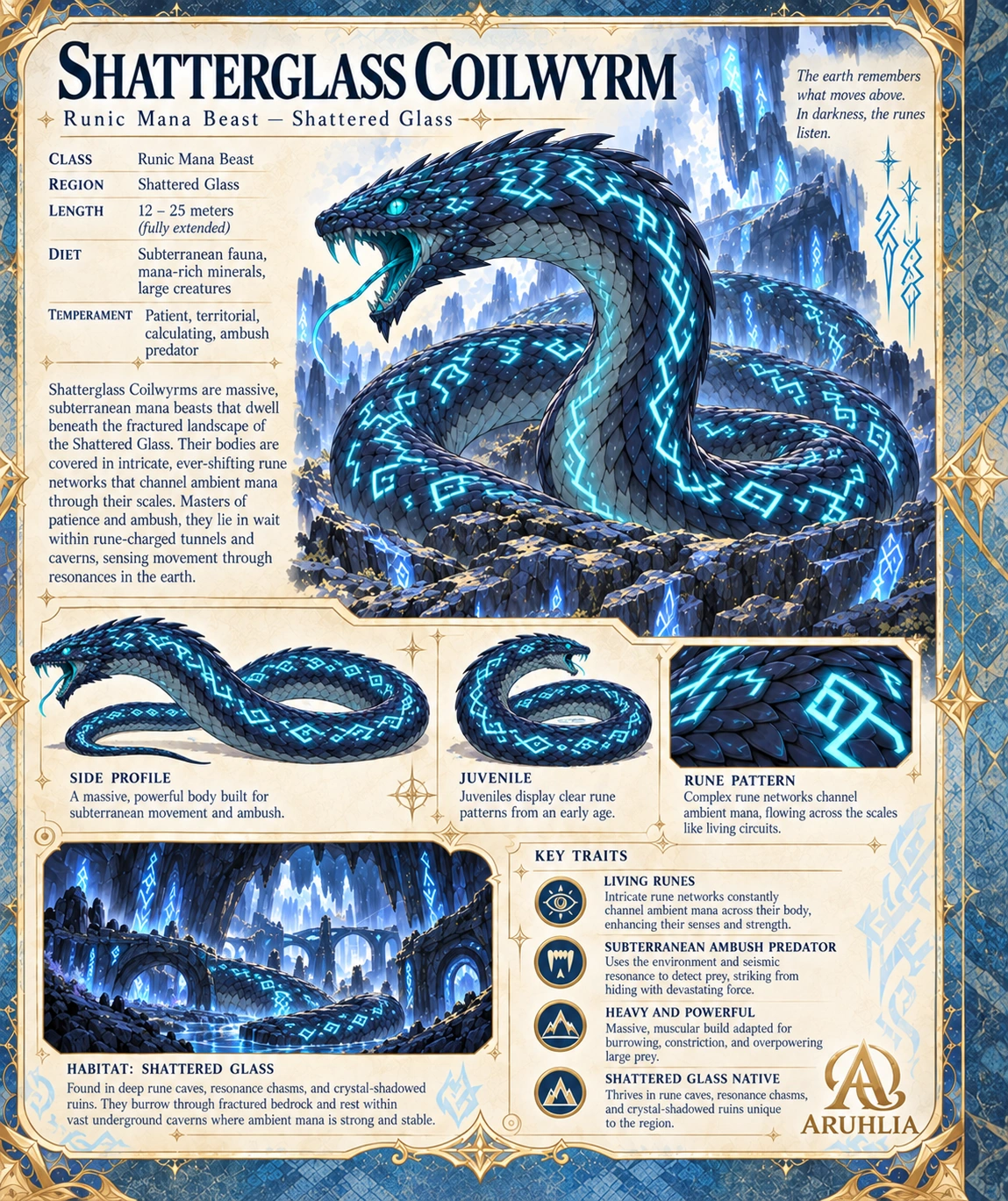
| Shatterglass Coilwyrm — runic | Limbless subterranean predator using connected galleries; rests between substantial meals | Continuous drag traces, missing burrowers, disturbed dust. A blocked passage may divert it into an otherwise quiet working gallery |
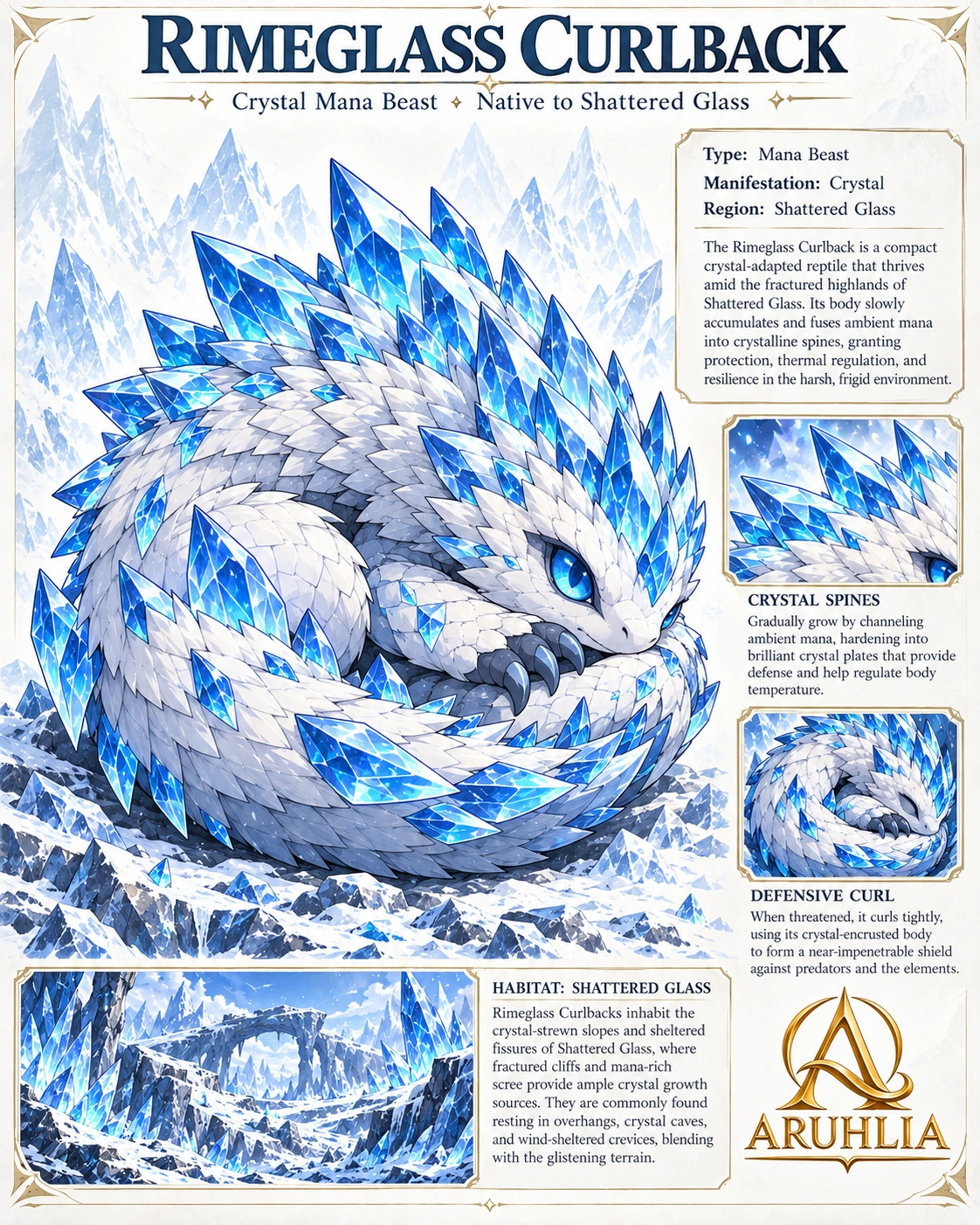
| Rimeglass Curlback — crystal | Compact crevice-dweller feeding on low vegetation and small invertebrates; curls defensively | Rounded resting depressions and scraped pale growth. Defensive posture is a warning, not permission to handle it |
| Crystalback Bulwark — construct | Occupies or patrols according to surviving mechanisms, directives, and condition; neither eats nor breeds | Repeated manufactured movement patterns. Salvage comprises components, not biological organs; intact ownership and function can be disputed |
| Shardclaw Scorpion — dual | Fissure ambusher taking invertebrates and small animals; vulnerable during molt | Burrow spoil and discarded molts. Recovered molt plates interest craftspeople; venom handling requires expertise |
| Runefrost Apex — runic | Solitary upland ursine omnivore with large feeding requirements; denning depends on local conditions | Broad tracks and feeding disturbance. Cold-pocket residence does not make the entire region its territory |
| Runedrift Stalker — runic | Territorial feline that selects concealment and escape lines; injured individuals may shift prey | Scrapes, cached remains, and a repeatedly avoided ledge. Rune-flow camouflage is not unlimited invisibility |
| Scriptwing Raptor — runic | Hunts across high spires and floating-isle air corridors; competes for nesting shelter | Circling, alarms, and feather remains. Storm or current changes can move hunting pressure toward inhabited approaches |
| Glyphmaw Warden — runic | slow terrace browser with recurrent feeding ranges and protected resting sites | Broad trails, cropped vegetation, shell rubbing. It is not a domesticated guardian merely because people call it Warden |
| Runeweaver Serpent — runic | Airborne predator following suitable mana-current corridors; its roosting and reproductive life remain poorly documented | Repeated aerial passes and prey movement. Distinct from the underground Shatterglass Coilwyrm |
Young, nesting, shedding, wounded, hungry, and experienced animals behave differently. A recurring Stalker can favor one shaded approach; a particular pack mule can refuse a polished surface after slipping there; one old Warden may return repeatedly to a familiar shelf. Individual habits do not apply to every member of a species.
Weather and seasonal work
Four recurring conditions organize local life without fixing a climate calendar prematurely.
Clear glare periods: Visibility becomes deceptive across reflective ground. Caravans favor sheltered approaches and low-angle light, while exposed workers shorten shifts. Bright weather can improve signals and worsen visual distance judgment simultaneously.
Rain and settling periods: Dust subsides, but wet surfaces, runoff, and newly loosened fragments change footing. Lowglint repairs soil walls. Prospectors inspect fresh debris only after the immediate fall hazard has passed. Rain is ordinary water unless a specific phenomenon is established.
Upland cold periods: High pockets become harder to reach; lower settlements can remain active. Wildlife follows food and shelter rather than obeying an arbitrary continent-wide migration date. Seasonal labor returns home and competes for fewer winter jobs.
Resonance episodes — magical weather: Local mineral formations begin humming, small fragments vibrate, and some equipment behaves inconsistently. Workers suspend sensitive cutting and assess the site. These episodes are bounded and variable, not automatic region-wide disasters. Their exact causes and numerical effects remain open.
Breeding closures, harvest windows, escort demand, and extraction schedules arise from observed local conditions. Their timing follows local conditions.
Work, commerce, and inequality
The production chain runs from survey and access negotiation through extraction, sorting, grading, preparation, packing, escort, and export. Each step employs people and creates opportunities for fraud. Raw crystal abundance does not imply a plentiful supply of flawless components or cheap finished Mana Glass.
Exports include graded mineral material, prepared components where technology permits, lenses, craftwork, and specialist services. Imports include selected tools, metal stock, cloth, bulk food during shortages, and goods that local soil or labor cannot supply efficiently. Prices vary with quality, scarcity, and the cost of transport.
Claims may belong to households, cooperatives, charter holders, or disputed estates. A surface owner can lack the money to open a seam; a wealthy creditor can acquire influence without owning the land outright. Labor advances secure work but can trap families when the delivered material is repeatedly downgraded.
Institutions and competing interests
The Facet Compact is an agreement among local producers, carriers, and settlement representatives. It standardizes sample custody and contributes to common-route repairs. Its weakness is enforcement against the richest members, who can threaten to move their trade elsewhere.
The Lowglint Commons is an association managing reserve provisions, shared equipment, and agricultural petitions. Its members disagree about whether to seek a long supply contract with a major buyer or preserve flexibility. A profitable contract may also leave little reserve for local households.
The Bluefacet survey crews are an occupational organization, not a replacement for any established military authority. They want reliable wages and the power to stop unsafe work. Merchants accuse them of self-serving closures; crews accuse merchants of paying for optimistic reports.
Mirrorford's bonded factors represent outside purchasers. Some finance useful equipment and honor contracts; others manipulate grades, credit, and rumor. Outside sponsorship gives factors influence beyond their own households.
The Uncut Exchange is an informal network of independent sellers and intermediaries. It includes legitimate direct trade, unlicensed extraction, fence operations, and people who use the same meeting place for entirely different reasons. Its participants do not answer to one leader.
Daily culture
Local fashion favors overlapping work layers, wraps, closed tool pouches, and surfaces that do not catch against sharp edges. Fine clothing distinguishes wealth through workmanship, lining, colored stitching, and selected polished ornaments rather than coating everyone in crystals. Dark skin, natural hair, varied bodies, and different ages appear throughout public life.
The Shuttering is a neighborhood evening custom: bright work lamps are screened, tools put away, and food brought into shared courts. It is practical and sociable, not a compulsory religion. The First Clear Market celebrates the reopening of dependable routes after a difficult seasonal interval; its date varies with conditions.
Courtship often happens around work and travel. A repaired clasp can be an intimate gift. Reserving a seat beside someone in a caravan may say more than a formal compliment. Long absences encourage devotion, infidelity, gossip, and relationships that survive only because both partners have separate livelihoods.
Funerals distinguish recovered remains from the missing. Families may place a dull stone in a household niche for someone lost underground, refusing a polished memorial until their fate is known. This is a regional practice with household variation, not a rule imposed on every faith.
Ruins, mysteries, and adventure sites
Ruins and local landmarks hold unfinished histories. A ruin is not necessarily a dungeon.
The Unstruck Hall: A ruined chamber whose hanging mineral ribs sound without visible contact during certain local conditions. It offers survey work, salvage disputes, and evidence of different construction phases. Its original purpose remains uncertain.
The Drowned Stair: A descending structure with intermittently flooded lower steps. Its upper landing is used as a contraband cache, creating conflict between investigators who want to drain it and sellers who want it left alone.
The Empty Cradle: A manufactured platform sized for a Bulwark that is no longer there. Tool marks and mismatched replacement fittings suggest maintenance across more than one period. The absent construct might have been removed, reassigned, or destroyed; its fate remains unknown.
The Bent Orchard: A cultivated pocket where repeated small ground movements have tilted old fruit trees. A family maintains it because the crop still sells well. Their successful harvest is evidence that the slope has not yet failed, not evidence that it never will.
Creature field guides
Eleven living Mana Beasts and one manufactured construct. The fully limbless Shatterglass Coilwyrm lives underground; the Runeweaver Serpent moves through the air. Glyphmaw Wardens are living creatures, while Crystalback Bulwarks are engineered guardians.
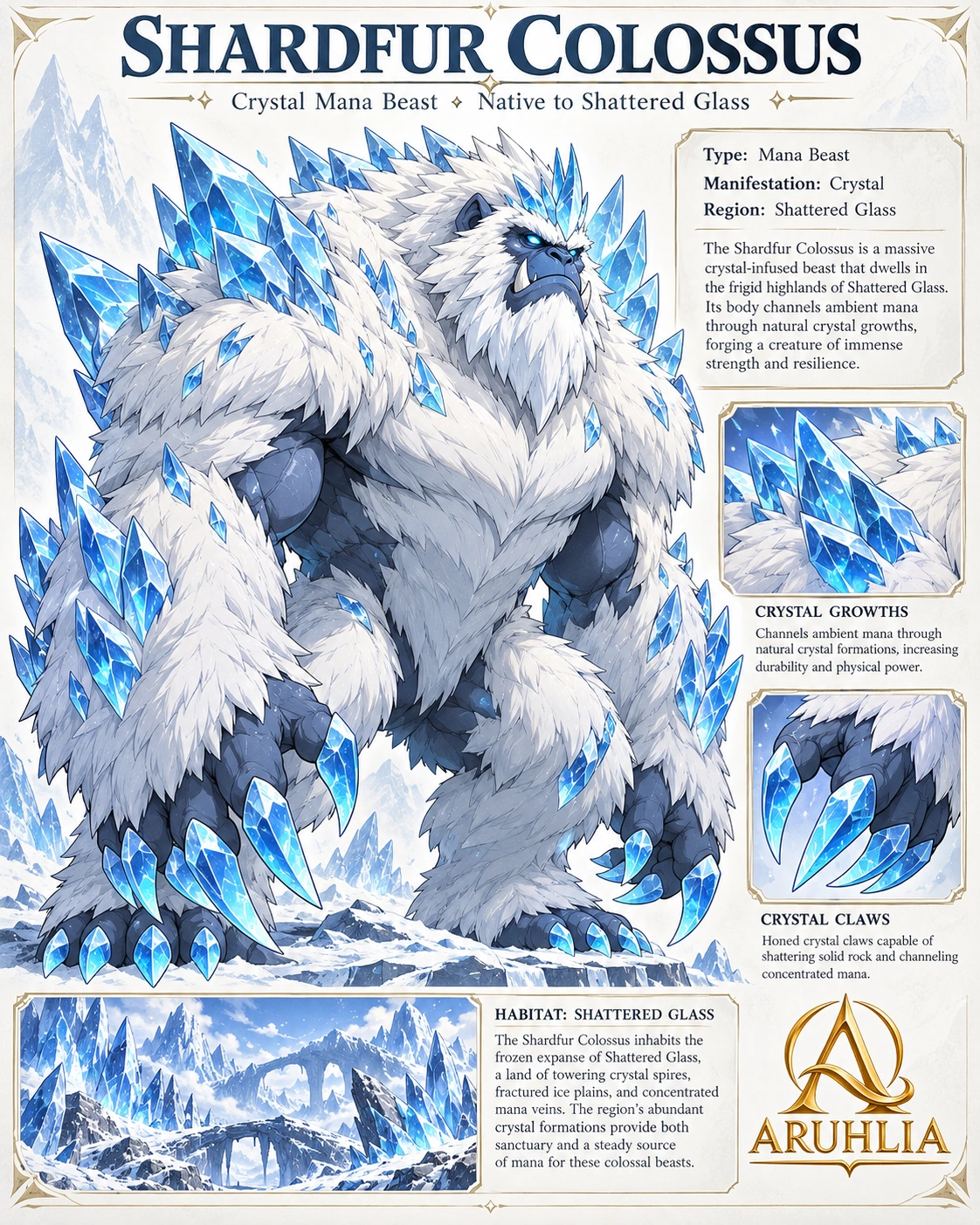 Mana Beast
Shardfur Colossus
Large crystal-armored, white-furred creature. Natural integrated crystals, not a construct.
 Mana Beast
Runeglint Skink
Small reptile with natural scaled skin and dynamic runic channels; no dominant external crystal armor.
 Mana Beast
Shardbeak Raptor
Aerial predator with both feather-associated runes and selective crystal growths.
 Mana Beast
Shatterglass Coilwyrm
Fully limbless serpentine underground predator; no legs, paws, claws or forelimbs at any age. Living rune networks along organic scales.
 Mana Beast
Rimeglass Curlback
Compact defensive crystal-bearing reptile; frigid artwork represents localized microclimate, not a statement that the entire region is frozen.
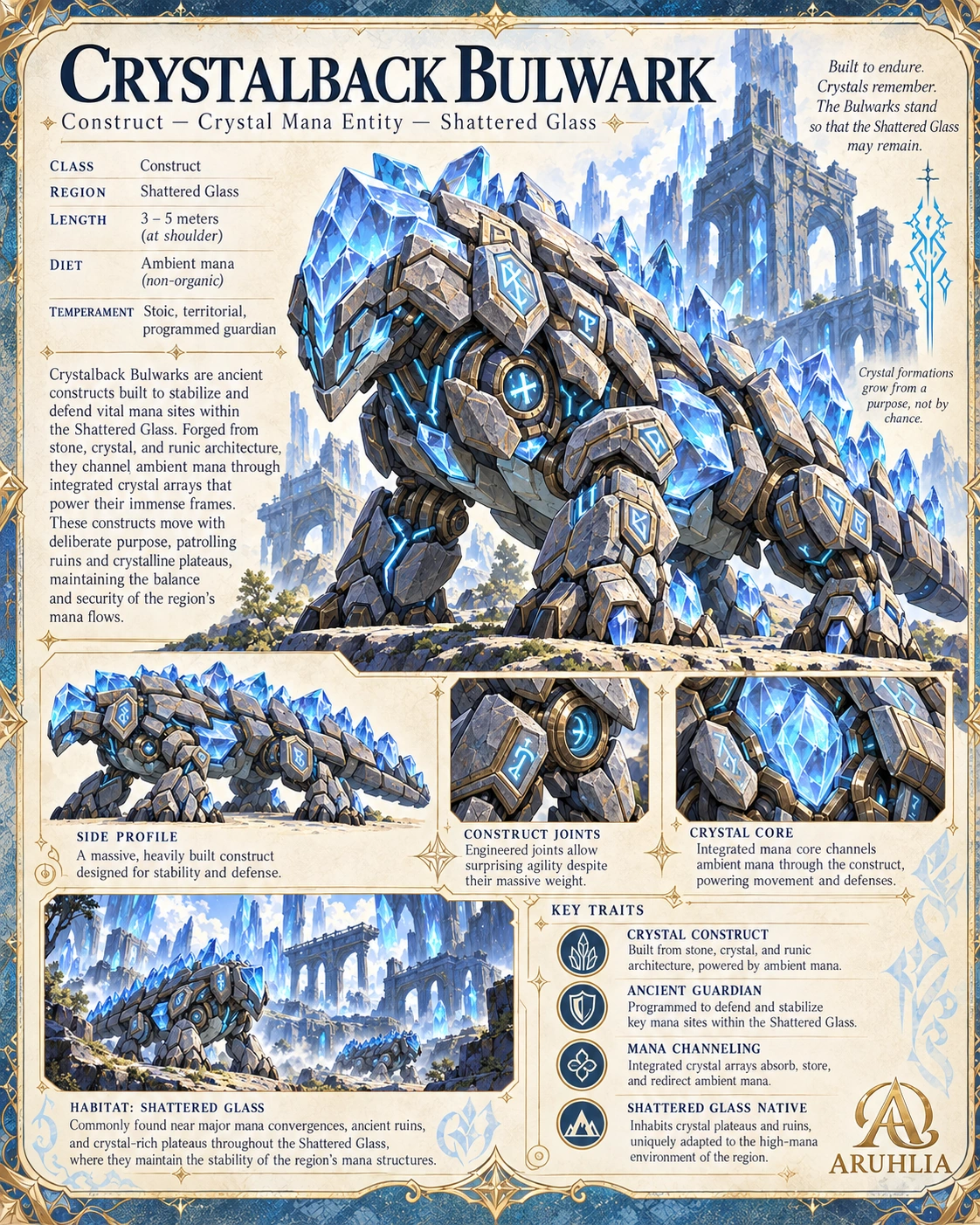 Construct
Crystalback Bulwark
Intentionally constructed stone/crystal/rune automaton, powered by a crystal core; not a breeding, feeding Mana Beast species. Mechanical joints and manufactured plates are defining.
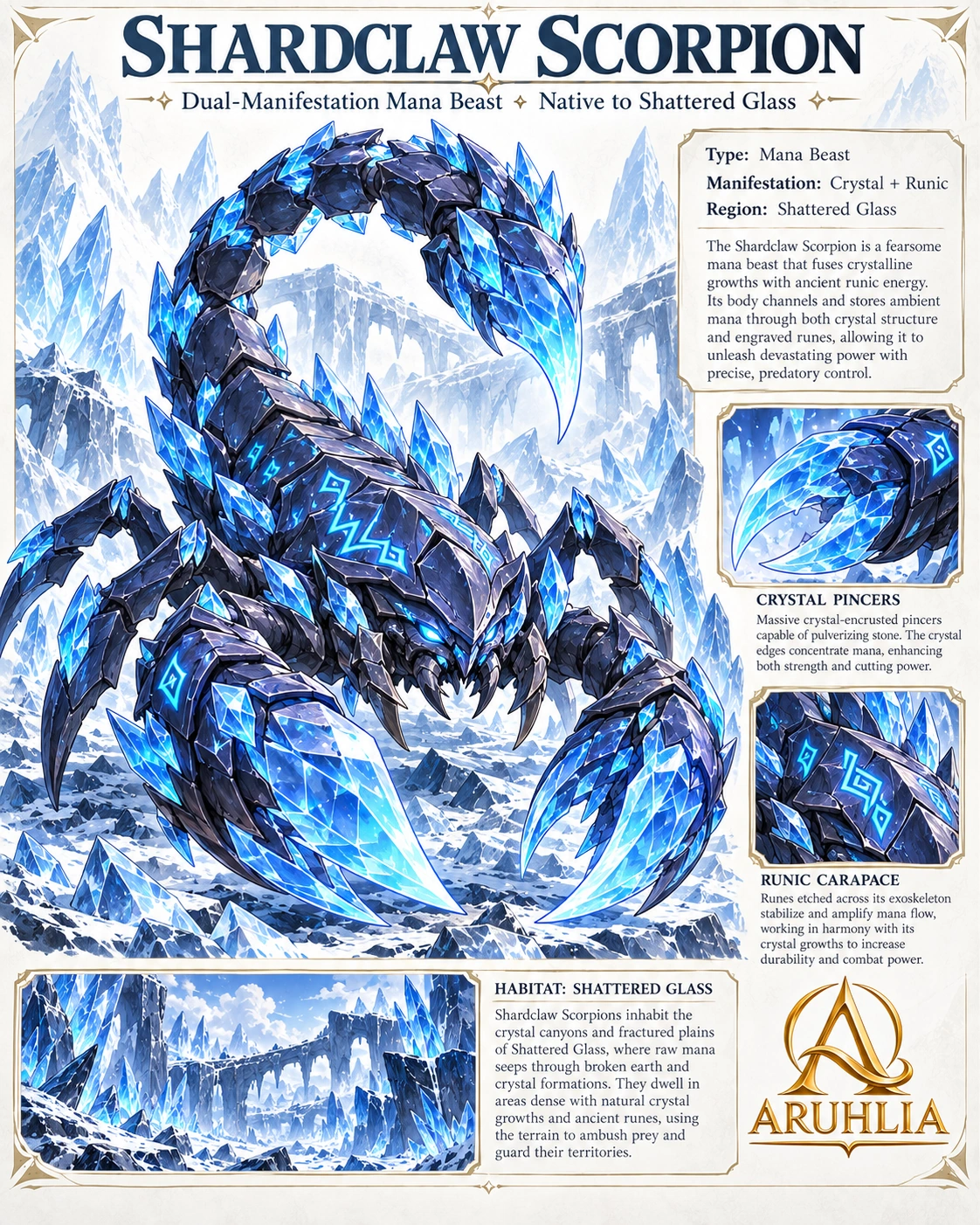 Mana Beast
Shardclaw Scorpion
Ambush arthropod with runic channels and crystalline pincers/stinger, not a construct.
 Mana Beast
Runefrost Apex
Large powerful white-furred ursine with biological rune networks, not crystal antlers or armored crystal spikes.
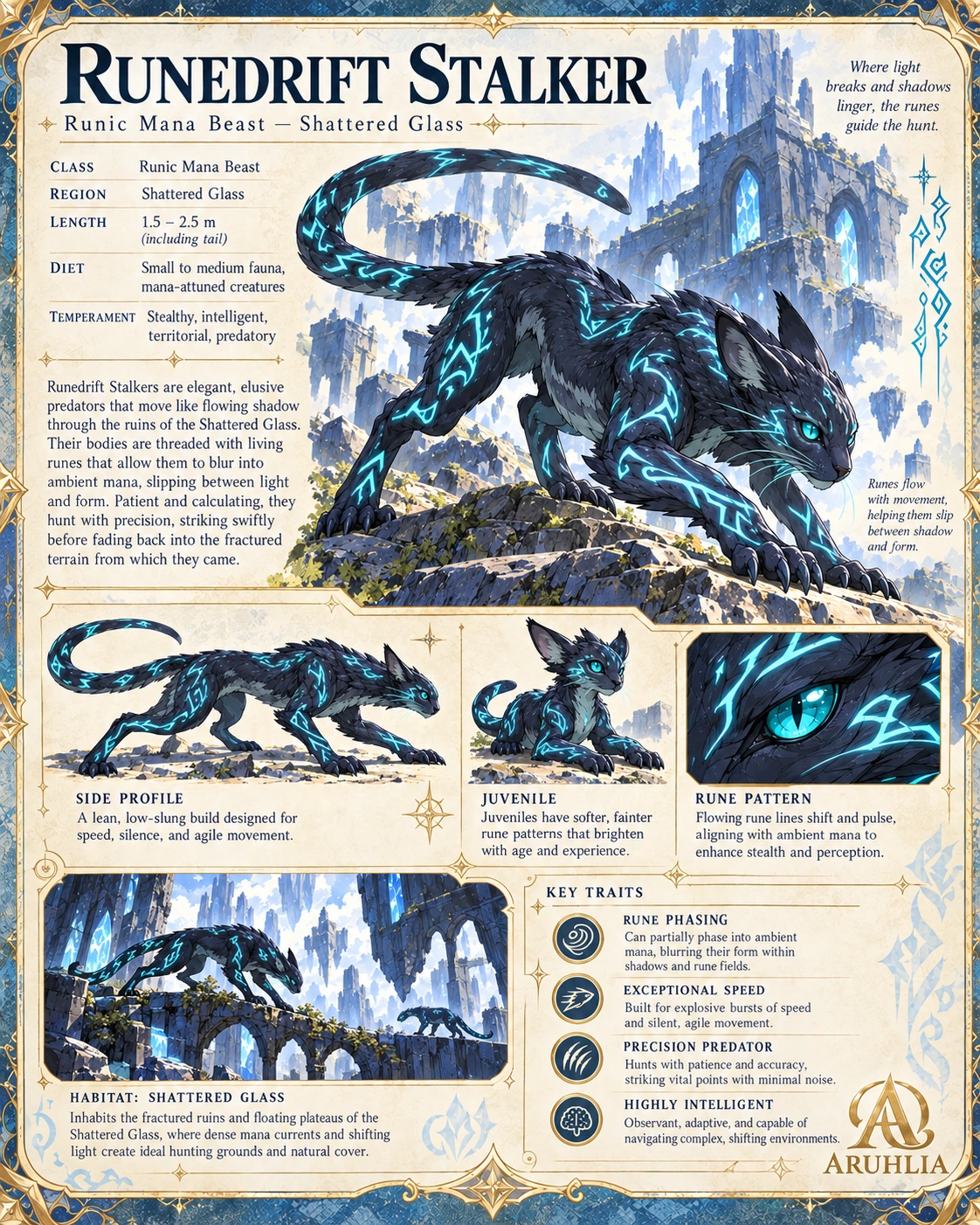 Mana Beast
Runedrift Stalker
Long-tailed feline predator, rune-flow camouflage and stealth; no mineral growth as defining anatomy.
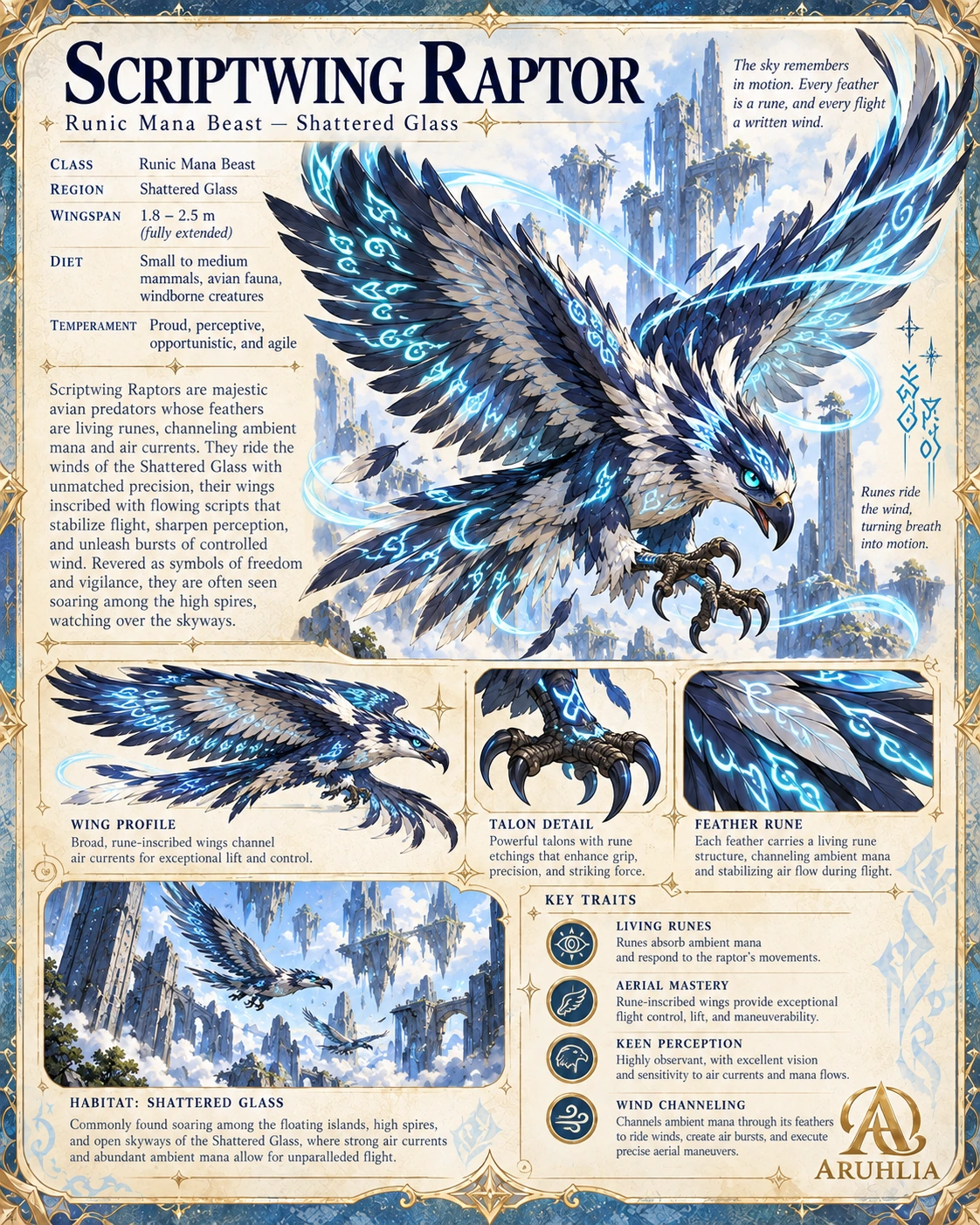 Mana Beast
Scriptwing Raptor
A distinct species from dual-manifestation Shardbeak Raptor; flight control via living runic feather channels, no crystal wings.
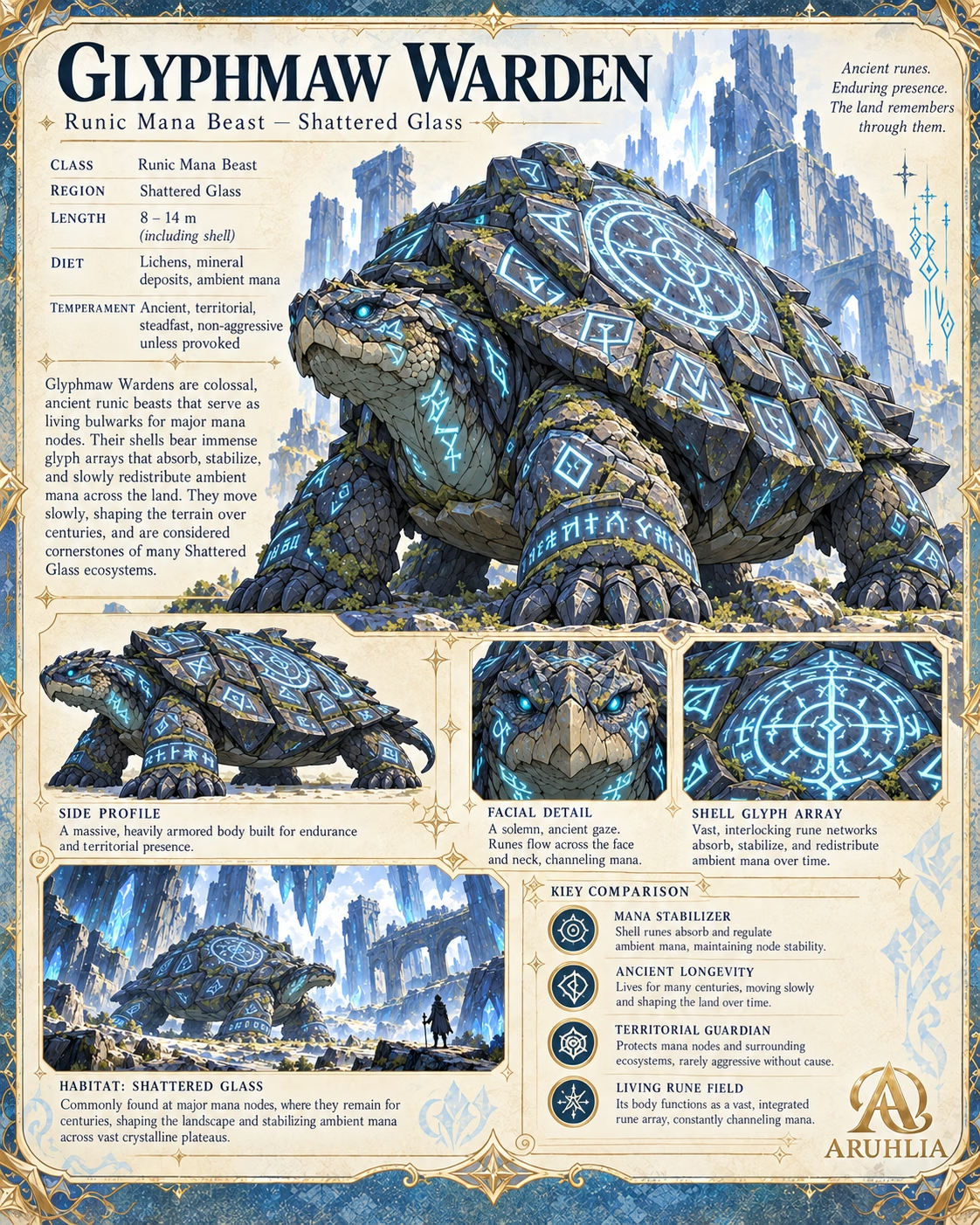 Mana Beast
Glyphmaw Warden
Living tortoise-like creature with shell glyph arrays (natural growth), NOT the engineered Crystalback Bulwark construct.
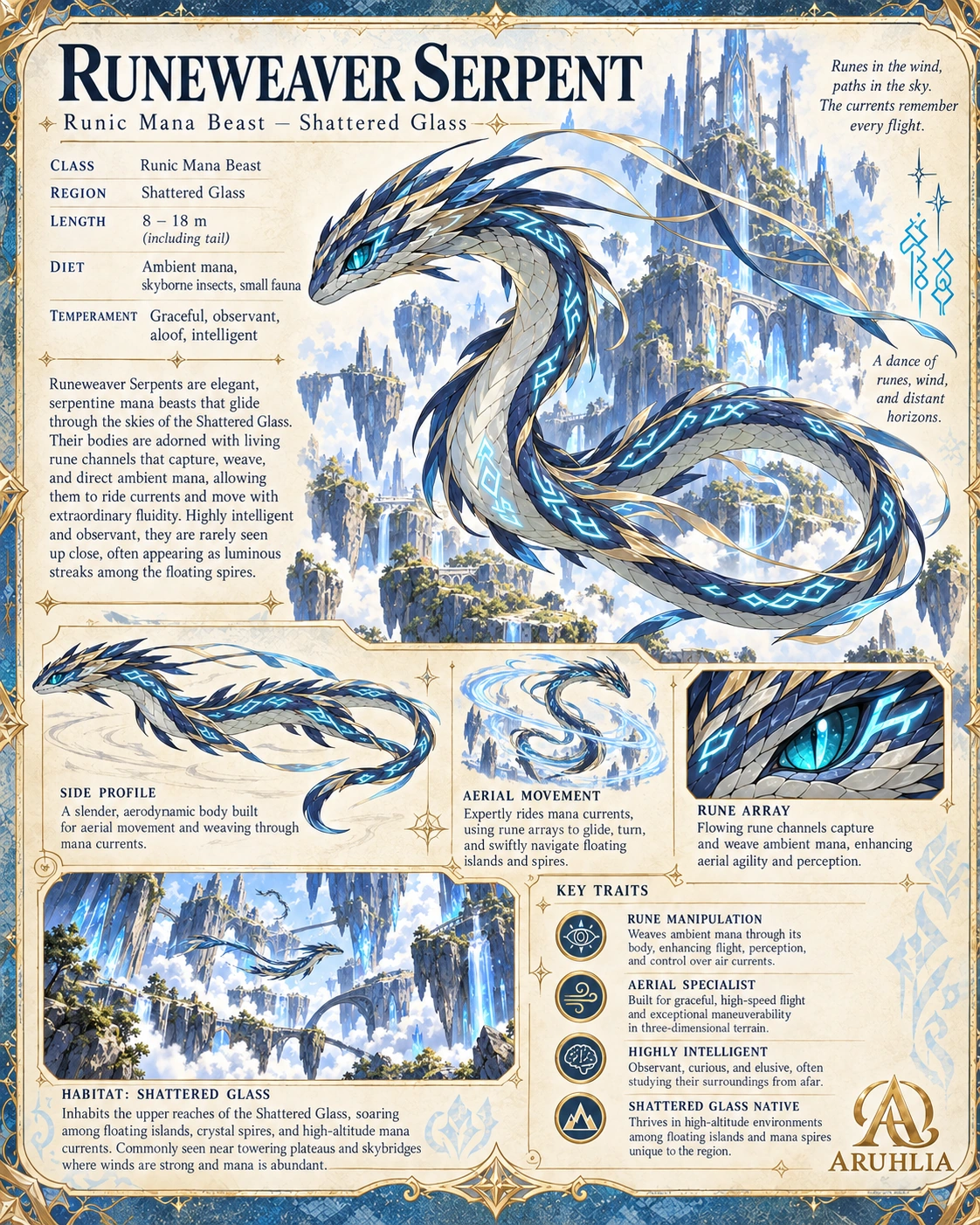 Mana Beast
Runeweaver Serpent
Slender airborne serpentine species, driven by living rune channels and mana currents; distinct from underground Coilwyrm.
Surface and deep habitats
Landscape plates show habitat types, rather than surveyed roads or distances.
Regional directory
Follow the places, plants and institutions into the Codex and Atlas.