
Skyturtle
A gentle airborne turtle whose oldest members carry living shell gardens through highland skies.
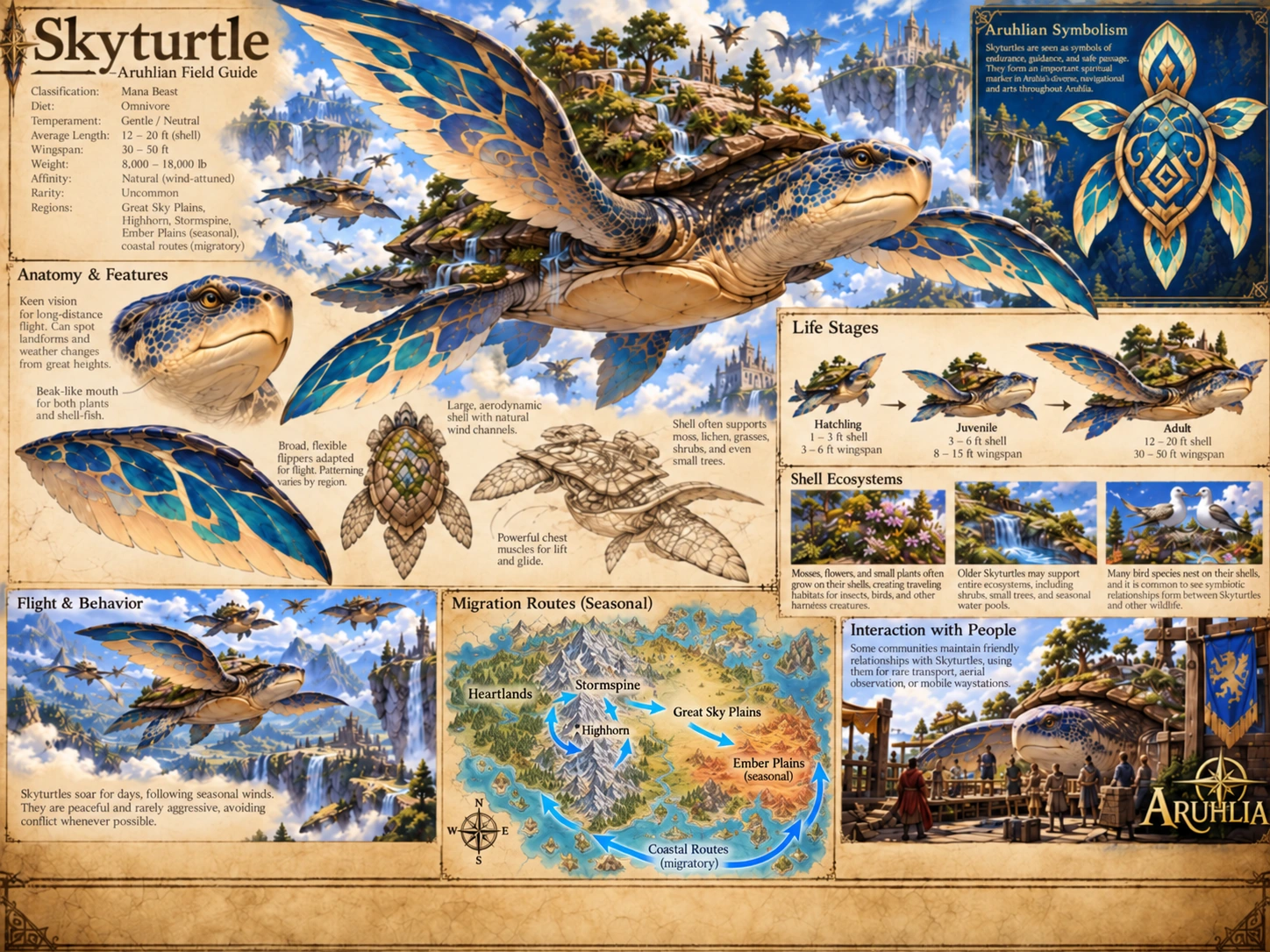
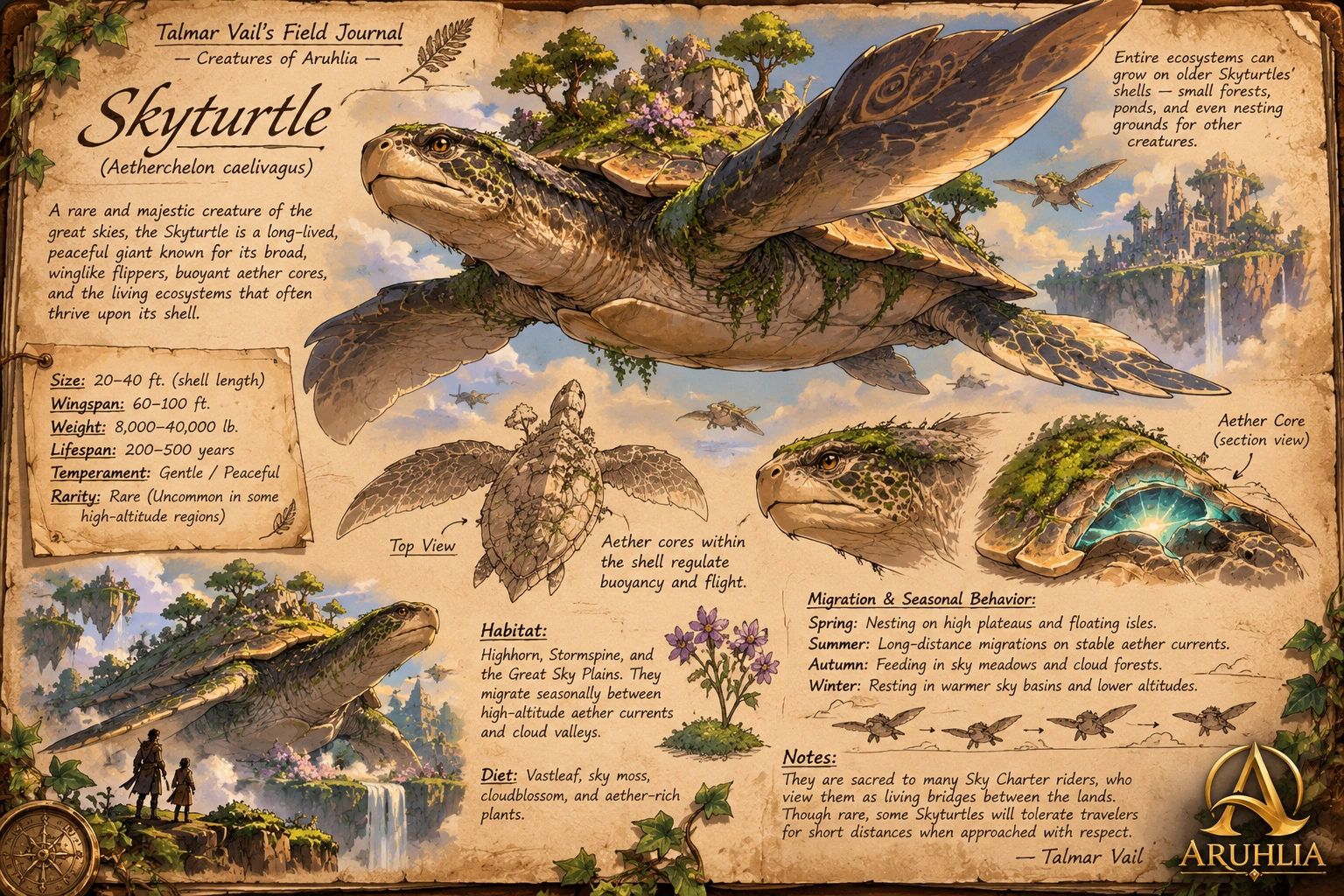
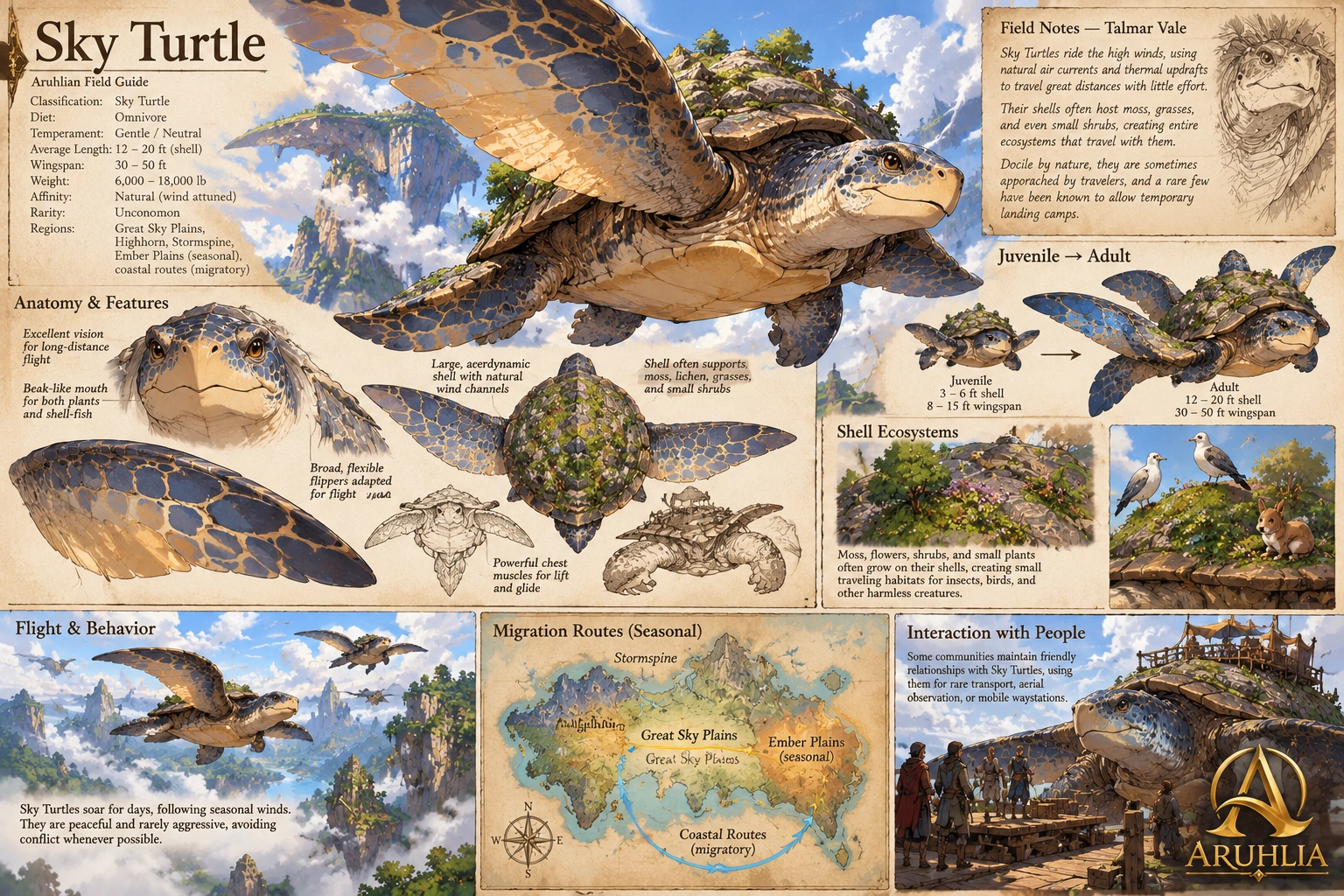
A broad beak, amber eyes, segmented shell and enormous featherless flippers define the Skyturtle. A mana-bearing organ supplies buoyancy while flippers stabilize flight and exploit ridge lift and thermals. Storms, icing and core exhaustion can force a dangerous descent.
Young shells measure roughly 3–6 feet; smaller adults 12–20 feet; elder giants 20–40 feet, with wingspans of about 60–100 feet. Talmar Vail estimates that long-lived giants can reach 200–500 years. These are broad field estimates.
They browse vastleaf, sky moss, cloudblossom and suitable highland plants. Moss, flowers, shrubs and occasional small wind-shaped trees colonize old shells. The burden remains limited by lift, water and shell area.
Their range includes Highhorn within Stormspine and the Great Sky Plains, with seasonal Ember Plains and climate-suitable coastal corridors. Spring nesting, summer soaring, autumn feeding and winter refuge follow local conditions; no fixed migration route or calendar dates are established.
Mostly docile, Skyturtles withdraw from disturbance. Nesting or trapped animals may defend themselves; their size and downdraft can be dangerous without predatory intent. Routine riding, permanent shell villages and commercial mount services are not established.
Tracking Info
Look for a slow-moving domed shadow, broad featherless flippers, low resonant calls, falling moss or seeds and heavy scrape marks at high resting ledges. A weakened animal may descend outside its usual season.
Deeper Ethology
Mostly docile browsing megafauna, traveling alone or in loose groups. Spring nesting, summer soaring, autumn feeding and winter refuge follow local weather and forage. Old shells support bounded gardens. Skyturtles generally withdraw, but can defend young or buffet intruders when trapped. Storm avoidance, injury and loss of lift may create rescue needs; routine riding is not established.
When This Is Wrong
A break from these patterns is a reason to investigate. Injury, hunger, breeding, severe weather, migration, displacement, disease, mana instability or learned responses to people can change behavior. Observe the context before deciding what the sign means.
Approved visual canon
Approved art archive
Each image is paired with this record so its identity and context remain attached wherever it appears.
Connected world
Follow the relationships
Each connection opens the matching canonical record or a focused Codex search when that subject does not yet have its own public record.
Mana Beast · Flying · MegafaunaSkyturtle
A gentle airborne turtle whose oldest members carry living shell gardens through highland skies.
Open record → Region
Stormspine
A severe mountain range of high roads, old powers, dragons, dangerous weather, and the inhabited Frost March in its far north.
Open record → Region
Ember Plains
A volcanic homeland where fire brings danger, fertility, craft, and renewal.
Open record →